1. Executive Summary
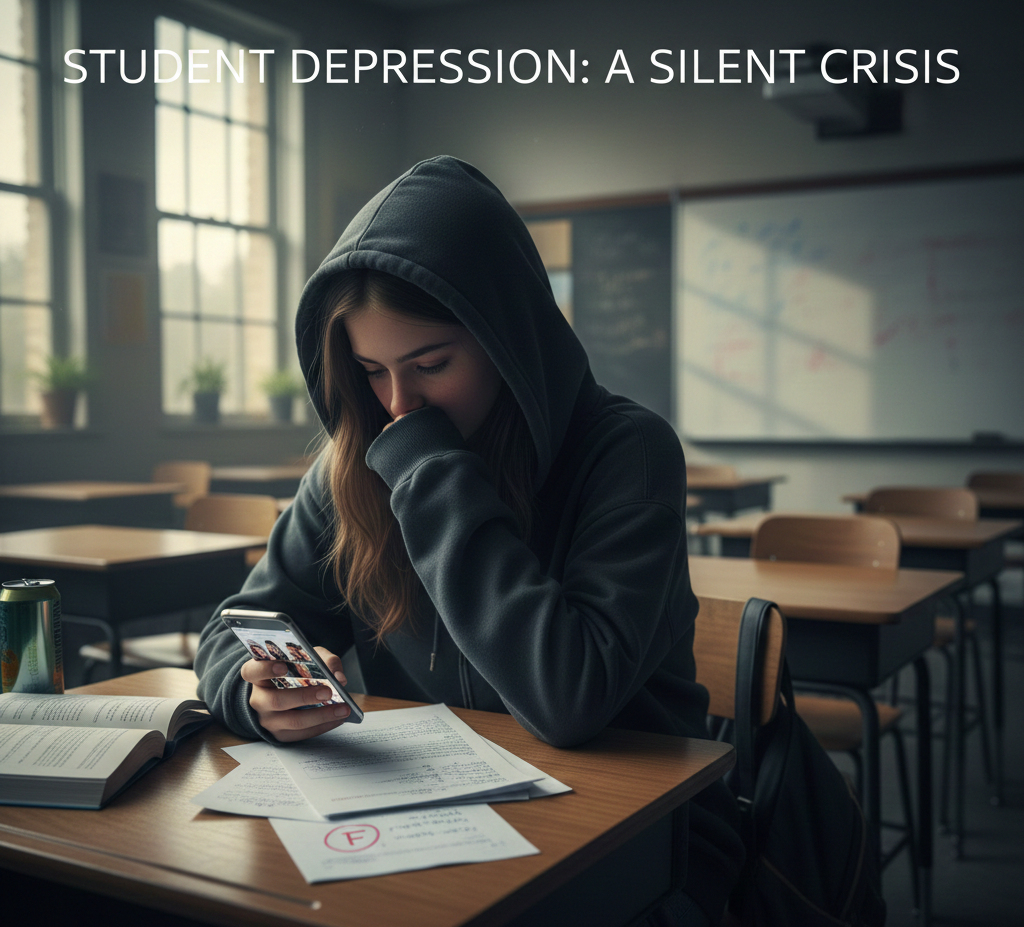
As we enter 2026, student depression remains one of the most significant yet “silent” hurdles in global education. While recent data suggests a cautious decline from the post-pandemic peaks of 2022, the numbers remain historically high. This report outlines why depression is termed a “silent crisis”—often masked by irritability or academic “laziness”—and provides a roadmap for educators and parents to bridge the gap between suffering and support.
2. The Current Landscape (2025–2026 Data)
Recent studies, including the 2025 Healthy Minds Study, indicate that while we are moving in the right direction, the scale of the challenge is still immense:
-
Prevalence: Approximately 18% of adolescents (ages 12–17) experienced a major depressive episode in the last year.
-
The Gender Gap: Depression remains significantly more common among female students (~25%) compared to males.
-
College Trends: Severe depression symptoms in college students dropped to 18% (down from 23% in 2022), but 52% still report high levels of loneliness.
-
The Treatment Gap: Alarmingly, 61% of teens with major depression receive no clinical treatment, often due to social stigma or lack of time.
3. Why It Is a “Silent” Crisis
Depression in students rarely looks like the “sadness” portrayed in media. In a school setting, it often wears a mask:
-
Irritability over Sadness: In children and teens, depression frequently manifests as anger, “attitude problems,” or extreme sensitivity to criticism.
-
Academic Misinterpretation: A sudden drop in grades or missed assignments is often punished as a “lack of discipline,” when it is actually a symptom of executive dysfunction caused by depression.
-
Social Withdrawal: Students may not cry openly; instead, they “disappear” into video games, solitary activities, or simply stop showing up for social events.
4. Key Drivers of Student Distress
-
The “Always-On” Culture: Students scrolling more than three hours a day on social media have double the risk of depression. The constant comparison to curated lives creates a sense of “never being enough.”
-
Achievement Pressure: Roughly 68% of teens report intense pressure to get top grades to secure their future in an uncertain economy.
-
The “Flourishing” Paradox: Interestingly, while depression rates are dipping, “flourishing” scores (feelings of purpose and optimism) are also low. Students are “getting by,” but they aren’t necessarily thriving.
5. Strategies for Intervention
To move from a crisis to a culture of care, the following multi-tiered approach is recommended:
| Stakeholder | Action Plan |
| Schools | Implement Universal Screening (like mood check-ins) to catch symptoms before they escalate. |
| Educators | Adopt Trauma-Informed Teaching, viewing “disruptive” behavior as a signal for help rather than a reason for punishment. |
| Parents | Normalize “Mental Health Days” and prioritize 8–10 hours of sleep, which acts as a biological shield against mood disorders. |
| Students | Participate in Peer Support Networks, as students are often more likely to talk to a friend than an adult initially. |
6. Conclusion
The “Silent Crisis” is beginning to be heard, but the work is far from over. The slight decline in 2026 statistics proves that institutional support—like increased access to telehealth and school-based counseling—is working. However, as long as 4 in 10 students feel persistently sad, mental health must remain as foundational to education as literacy or mathematics.